
Taranaki Rock
February 2008
Story by Paul Grimwood
Eleven Wellington rock warriors (say that quickly) travelled in 3 cars to climb the rock of Taranaki. However, for now, let us ignore the large sample and interesting analyses such as mean passengers per vehicle and deal with a single representative transit module (a Toyota Carib for the anally retentive). The trend these days is to draw massive conclusions from meaningless data: ‘House price growth in the 3 months to January drops from 10.1 to 8.9%’ shock horror. Should the trend continue and reach zero percent growth we predict a levelling in house prices! Right, back to the trip: 46 litres of 91 were consumed in order to ferry 4 persons plus gear from Wellington to North Taranaki, a total trip distance of about 640 km (7.2 l/100km for the anal retentive). Of those 4 people, 1 of them scaled 7 climbs, 2 topped 6 and 1 bagged 5, which when presented graphically would render as a beautifully symmetrical bell-shaped normal or poisson distribution, with a convenient mean and mode of 6 climbs per person, or about 1.9 litres of fuel per climb to take things in a environmental direction. To put these data in perspective: On a recent trip to Turakirae – a considerably shorter distance from Wellington - 3 climbers in a Subaru Impreza, which is kind of irrelevant since there are no petrol consumption logs for the journey, failed to climb any boulders successfully, and since when you divide something by nothing things tend to skyrocket, our trip to Taranaki was better for the planet by several orders of magnitude. It’s not what you would think really is it. Less travel time equals less petrol and more climbing time should equal more climbs. A lower fuel to climb ratio and healthier for the environment, one would think. Whether these startling data are consistent with some sort of ‘the further you travel the more climbs you do’ hypothesis or a dramatic increase in talent admittedly remains in the balance. Either way it seems likely that should the trend continue, when we go to the Arapiles in March, we will be climbing a lot.
Climbing trips to Taranaki tend to take all weekend. After all, it does involve 640 km of driving plus there is a big walk up a steep hill in the middle of the night. Dinner is more or less inevitable at some point, usually in the evening after some climbing. On Saturday night – at dinner in fact – a further important and statistically significant discovery was made during an ad-hoc epidemiological study conducted despite the fact that most peoples brains had shifted into some sort of energy efficient sleep mode. Yes, more rich conclusions from semantically sparse data. One food group cooked up a hotter and spicier concoction than expected. The air at Tahurangi Lodge was saturated with chilli fumes for a short while and there was much coughing until windows were opened. On masticating, the two male members of that particular gastronomic unit started to perspire in the eyelid area. This is OK as it turns out. Clearly, it’s a physiological fact that men have more sweat-like ducts in the eyelid region than women and these ducts or glands react to a number of stimuli funnily enough none of which is ambient temperature. So guys, next time you start to choke as The Pogues come on the jukebox singing ‘Dirty Old Town’ and you’re feeling all emotional after necking 5 pints of beer on an empty stomach, maybe you’re reminded of your brother and when the world seemed an easier and better place, rest assured, your manhood is intact, you’re not really crying, it’s just eyelid perspiration.
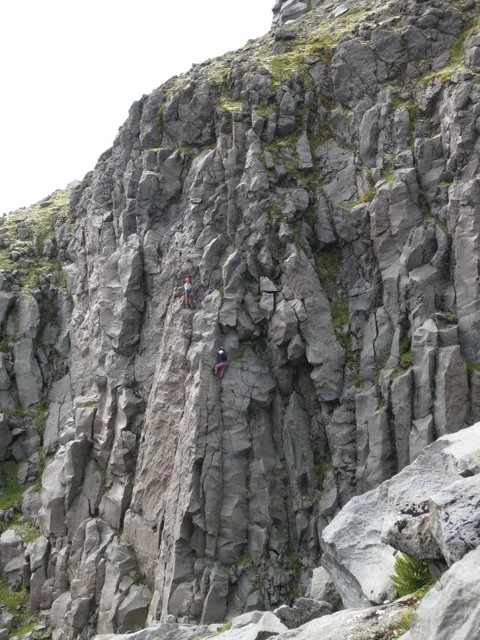
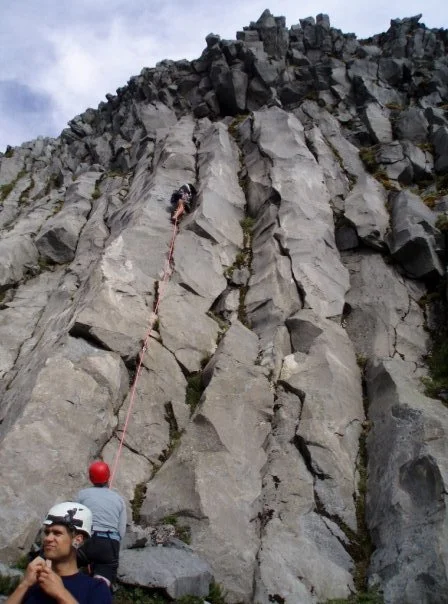
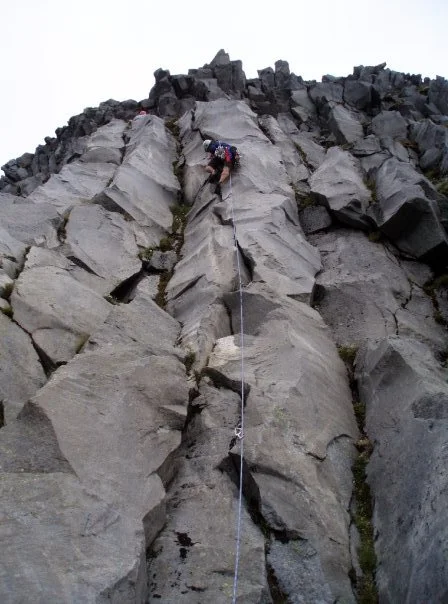
Anyway back to the trip and more data, more statistics, but serious this time because this is after all meant to be a climbing report and climbing can be dangerous and beta should not be tainted. We climbed hard on the Saturday as rain was forecast for Sunday. To minimise wasted time most of us stuck to one area: a 20 m stretch of the Organ Pipes around the Left Nostril with a clutch of routes in the 14 to 16 range. I found the rock to be sound, many of the routes worthwhile and protection generally good. The guidebook was accurate in its grading and rating and the starred routes were all fun. All of the routes here require placement of natural pro with many routes focussed on crack lines although often the face has a number of ledges and holds. Routes were around 20 m and generally required building a natural anchor. The guidebook talks of walking off but we tended to rap off a rope slung around a rock. As well as climbing on the Organ Pipes, James and Simon climbed Planet Hemp (18) on Little Eiger wall and said it was a good climb and then top-roped the 21 to its left and then Pills and Thrills (17) or something like that, both of which were also worthwhile although they reckoned the 21 was over-graded. I don’t have a guidebook, hence the vagueness. You need a guidebook to climb at Taranaki by the way. So we only touched the tip of the iceberg that is Taranaki rock. I’d be keen to go back. A wise person might consider leaving around lunch time on Friday and taking Monday off work and checking the weather forecast to ensure Saturday and Sunday are going to be good in order to improve on 1.9 litres of fuel per climb. On Sunday it did rain so we headed home, end of story. Thanks to Alison, Blair, Nicky, Amanda, Dave, Lezar, James, Simon, Merewyn and Josh for a good weekend and an extra big thanks to James for leading the trip.