
A Year in Antarctica
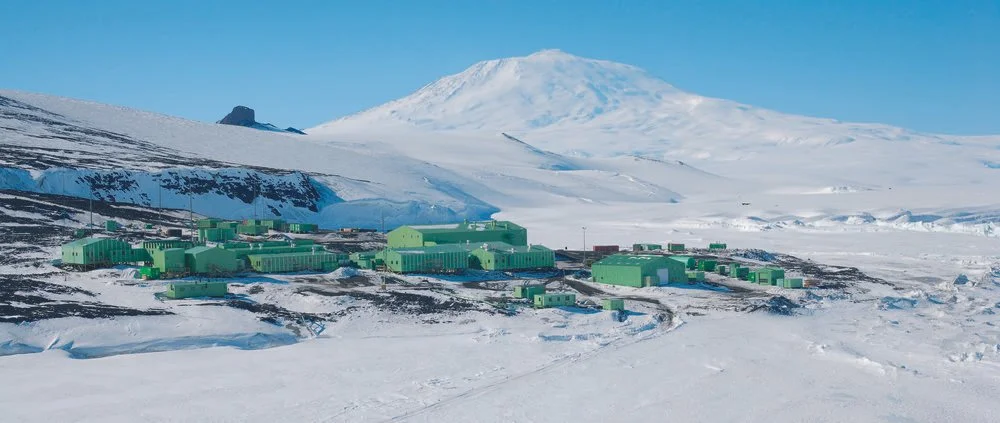
Dispatches from Pete de Joux
Pete’s Post from Antarctica - November 2005
By the time you read this I will be back home. I feel very privileged to have experienced the full four seasons here, but it has passed very quickly. The winter was definitely the best part, and anyone who only comes here during the summer is missing an amazing experience.
Our replacement crew arrived last week, and the population of the base has risen from 18 to 55 people. The “newbies” are all very excited about being here, and are constantly staring at the view out the window, or at the temperature gauges inside the base just like I was a year ago.
My handover to the new science technician has been completed, and I’ll fly back to Christchurch tomorrow. I have a few days of debriefing and then its home to Wellington. I’ll start back in my regular job two days later.
There are a few things that I will miss, and some that I won’t.
I won’t miss the smell the of the wastewater plant. All our sewage is treated in a biological plant very close to my lab, before being discharged into McMurdo Sound at a quality that is no worse than the background bacterial levels of the sea. Unfortunately, the “poo plant” doesn’t always cope well with changing population numbers on the base – particularly in summer. The vents from the poo plant are also very close to the fresh air intakes for the rest of the base. When the wind blows from the wrong direction…. well I guess you can imagine what its like.
I’m looking forward to having two-day weekends again, and not working on every single “day off”. We work whatever hours are required down here, and the daily weather observations still need to be done at 9am every day. I have to provide support for the computer systems, and people seem to have a lot of computer problems on Sundays.
I will miss the camaraderie of a team that works together to support each other. We were just like a big family, and I can honestly say that they have been a high-quality bunch of people to spend time with. We had lots of laughs, but most of all I was impressed with the competence of the base staff. Every one of them was good at their own job, but could also help with just about anything else that needed to be done.
One of the highlights was flying by helicopter to the Darwin Glacier to install a weather station. This remote and rarely visited area is 300km south of Scott Base, and will be the site of intensive science study in the next few years. We had about an hour of ground
time to do our job, and had just completed it when the helicopter returned to pick us up.
The other highlight was being part of the Joint Antarctic Search And Rescue Team (JASART), and training with them every fortnight. We had a lot of fun, and I’ve made some very good friendships with the two other kiwis and the ten Americans on the team.
I’m looking forward to catching up with all my Alpine Club friends when I get back. Don’t ask me if I saw any polar bears – they’re only found in the Arctic.
My standard answer to the polar bear question is “Yes, there’s one behind every tree”.
Pete DeJoux
Pete’s Post from Antarctica - October 2005
Yesterday I stood in the sun for the first time in several months. Astronomically speaking, the first sunrise was ten days before this. But Scott Base sits at the bottom of a hill facing south, and the sun needs to be well above the horizon before we emerge from the shadows.
It is interesting how some small things can become very important. We were all quite excited about seeing the sun.
Last week was the “winfly” period. During the week we received four flights from New Zealand of C-17 Globemaster aircraft. These aircraft are operated by the United States. I was out at the Pegasus ice runway when the first flight landed. Some people were cheering, because winfly marks the end of the winter period of isolation.
Personally, I had mixed feelings as I watched the aircraft arrive. I was happy because it would bring us fresh food, mail, and parcels containing new toys. But it was also a little bit sad. I had really enjoyed the winter experience, and now it was over.
It also means that my year on the ice is drawing to a close. In six weeks time the summer series of flights will commence. These are the “mainbody” flights that bring in our replacement crew, lots of scientists, some VIP’s, and all the hustle and bustle that occurs when a seasons worth of activity needs to be compressed into the three or four months of summer. I’ll have a week or two of handover to the incoming technicians, and then I’ll be returning home.
Winfly brought us an influx of people, and things were very hectic during the week. We had a change of base manager. Our chief executive also came down to inspect the new Hillary Field Centre, and was very impressed with the fit-out work that was completed by our winter crew. We also had a few scientists and technicians come down to perform maintenance checks on their instruments.
In preparation for one of these science visits, three of us had driven out onto the sea ice a week earlier. We went about 20km northwest of the base to drill holes and assess the ice thickness. Some years the ice in McMurdo Sound breaks up and drifts away, but this hasn’t happened for the last six years. Consequently, the sea ice is quite thick but also of an inconsistent quality where melt pools had developed on the surface during summer, and subsequently refrozen. I’ve seen video footage from previous years of minke whales swimming twenty metres in front of the base, but we weren’t so lucky this season – the ice remained frozen but severely fractured.
The sea ice where we drilled was about five or six metres thick. We’d expect new ice to be one or two metres thick at this time of the year. The inconsistent quality of the old sea ice is causing concerns for the Americans, who normally build a sea ice runway close to their base. This significantly reduces the travel distances, as the Pegasus runway is 40 minutes drive away on the permanent ice of the Ross Ice Shelf. This year, the only solution will be to build the sea ice runway in the area where the icebreaker ship cleared a channel through McMurdo Sound during the summer. This will be new ice about 1500mm thick, but it contains lots of frozen-in blocks of ice debris that the ship had smashed up. It will take a lot of preparation to achieve a smooth surface suitable for landing an aircraft on.
It is also a busy time for science. Much of the science in Antarctica involves climate change and ozone destruction. The months of August and September are when most of the ozone destruction occurs. The chemical reaction occurs on the surface of special clouds called “polar stratospheric clouds” or “nacreous” clouds. It requires cold conditions plus sunlight, which is exactly what we have at this time of the year. Nacreous clouds have a beautiful pink and blue mother-of-pearl colouration, and most people never get a chance to see them.
I look after several instruments that measure ozone levels, as well as the quantities of other chemicals in the atmosphere. They use a number of different techniques; a couple of these are the measurement of ratios of light wavelengths absorbed by ozone compared to wavelengths that are unaffected by ozone, and measurement of the 278 Gigahertz radio emissions of chlorine oxide molecules, which exist when ozone destruction has occurred.
Next month’s instalment is likely to be my last, and by the time you read it I’ll be suffering in the hot and humid weather in Wellington as I try to reacclimatise.
Pete DeJoux
Pete’s Post from Antarctica - September 2005
“Here’s the situation”, said Lonnie, the Winter SAR Leader. “Jack and Jill were walking the Castle Rock Loop, when they had an argument. Jack stormed off in anger, and has checked back into McMurdo Station. Jill hasn’t checked in, and is now two hours overdue. We’ve searched everywhere in town, and it is assumed that she isn’t here. That’s all the information we have”.
The temperature is minus 30 degC and there’s a 20-knot northerly wind. This means serious windchill - the human body will lose heat at the same rate as on a calm day at minus 60 degC. Anyone stuck in the open, or down a crevasse will be in serious trouble.
“Pete, I want you to take command of the team today. Bo and I are both unavailable.”
My heart rate went up a notch or two. Why me? I’d better do a good job - someone’s life might depend on my decision-making. The first step is to send out a hasty team to drive around the Castle Rock Loop to check any shelters. They will concentrate on covering the ground fast, rather than a thorough grid search. Meanwhile, the rest of the team will assemble all our medical and rigging equipment into another vehicle.
“Jay, you’re our primary medic. Can you take a small medical kit and go with Rex and Jack. I’d like you to take a PistenBully vehicle and drive around the Castle Rock Loop from the Arrival Heights end. Stop and check the NASA satellite dome, the two emergency shelters, and anywhere you see open crevasses or footsteps. Just take a climbing rope and your personal gear. Let’s get moving as quickly as possible, and give me a radio check on MacOps frequency when you are mobile. Any questions or suggestions?”
First task accomplished. I’d got the hasty team away.
“Greg, can you please start loading the rest of the medical gear into the Hagglunds. Deborah can help you. We’ll need the Stokes Litter, KED and SKED, as well as the hypo-wrap and normal medical kits. The rest of us will concentrate on loading all the rigging gear and ropes. We’ll take the Arizona Vortex in case we need to rescue Jill from a crevasse. Let’s aim to be away from here in fifteen minutes. Any questions or suggestions?”
What else do we need; have I forgotten anything; have MacOps been informed; is the doctor on standby? Is my personal gear all ready to go; is my own radio on the right channel? Yes, it must be - there’s the test call from the hasty team.
“Hedley, will you drive the Hagglunds. Greg, can you sit up front and use the spotlight to look for footprints, especially when we get near the icefall. I’ll sit in the back seat so I can concentrate on communications and logistics. We’ll drive out to the other end of the Loop, and search the CosRay buildings as we go. We’ll also search the emergency shelter at Silver City, and the toilet building at the skifield. I’d like to stop at Crystal’s Crack where we’ll walk along in front of the Hagglunds for 200 yards with spotlights in case Jill walked off the road and fell in the crevasse. We’ll do the same for the big crevasse across the road up the Kiwi Ski Hill. Now does anyone have any additional ideas, or is there anything I’ve forgotten?”
Once we were under way, my stress levels went down a bit. We searched various buildings, and heard on the radio that the hasty team had done the same. It was reasonably sheltered on our side of the hill, but the hasty team reported very cold conditions with moderate visibility on the windward side of the ridge. We checked the crevassed area known as Crystal’s Crack, but there were no signs of any open crevasses or any human trail. We continued up the hill beside the skifield that Scott Base operates during the summer, and stopped at a well-known crevasse marked with crossed flags.
“There’s something in here”, shouted Deborah, who had quickly roped up and ventured to a collapsed part of the snow bridge right beside the road. “It’s Jill”, she said once she shone the torch down the hole. “She’s on a dodgy snow bridge about ten metres down. I can see the crevasse is much deeper than that – maybe another fifty metres.”
While I contacted the hasty team by radio, I asked Deb and Greg to set up a personal snowstake anchor, and to abseil down to Jill. Their first task would be to secure her from falling any further, and provide reassurance and warmth while we prepared a hauling system to extract her. They would put a cervical collar on Jill to support her neck, and would manoeuvre her into the litter or KED that we would be lowering down once we were ready. Hedley’s job would be to stay at the edge of the crevasse (roped to a personal anchor) to provide a safety overview and a communications relay between the people down the crevasse and the rest of us on the surface.
This is good, I thought to myself. We’ve got three kiwis here to boss around these ten yanks. We won’t need any big discussions about how to do things. Hedley will keep an eye on the people down the slot and Blake can supervise the building of the belay system and anchors. I’ll supervise the construction of the main hauling system, anchors, and assembling the Arizona Vortex. These Americans are very good at what they do, but sometimes they waste too much time talking about it first.
Building the anchors was quite quick. For each of the two rope systems we dug four T-Slots and equalised them together into a bombproof anchor. We were slightly cramped for space, because I decided to keep everything on the area of snow that is surveyed and marked as a road. This saved us having to probe out the surrounding areas for hidden crevasses. We also used slings connected to hardpoints on the Hagglunds vehicle as a backup anchor.
The hasty team had arrived mid way through the construction phase, and all three of them quickly fitted into the new roles I allocated them.
The Arizona Vortex is a large kitset tripod with a pulley that we use at the edge of the crevasse or rock face we are raising the victim from. It makes the top transition from vertical lifting much easier, as the rope doesn’t bite into the snow at the edge. Because it is quite heavy, we often leave it behind. But it is perfect when we can drive right up to the rescue area.
Within about 50 minutes, Jill and one of her attendants was hauled out on a static rope with a 9:1 pulley system. We’d put her in a KED to support her spine, since space in the crevasse was too limited for a Stokes Litter to be practical. The belay team provided a safety backup on a separate static rope using a tandem prussic belay. The other rescuer had to prussic out of the slot on the same rope she had used to abseil in on.
As soon as Jill was out, we put her on a backboard and placed her in a hypo-wrap to warm her. We loaded her into the Hagglunds ready for transportation to the medical centre. It only took a few minutes to de-rig and clear the site, and we all headed back to McMurdo for a debrief.
“In all the years I’ve been coming here”, said Lonnie, “this has been the smoothest running scenario we’ve ever had. Well done, everybody”.
It was only a scenario, but the stress was real, the darkness was real, and the cold was real. Personal safety was just as important as in a real rescue too.
We haven’t had a “real” callout this season, and I hope we don’t have one. But we’ve got a very competent team, and we take our training very seriously. And we have lots of fun with our American friends.
Pete De Joux
Pete’s Post from Antarctica - August 2005
last night i had a great idea for my Vertigo piece this month. I decided to start writing it in the morning. Today I am able to remember that I needed to write this article, and that I came up with a theme last night. But I can’t remember what the actual idea was. So I’ll tell you about Polar T3 syndrome, which most winter-over personnel seem to suffer from. One of the symptoms is forgetfulness.
We’ve all been medically and psychologically cleared as fit for wintering-over in Antarctica. We were recruited partly because we’re supposed to possess personality traits that will allow us to cope with the isolation, cold, darkness, and living in a close community of workmates. And we’ve all got a sense of humour that makes us laugh at the silly things we sometimes find ourselves doing.
All of us at Scott Base have had experiences like collecting the tools to do a job, walking to the other end of the base, and then trying to remember what the actual job was. Or walking to the computer to send an email, and then forgetting who we wanted to write to.
My memory is normally much better than this when I’m living in NZ, and my workmates are the same. So why are we affected like this? It actually doesn’t come as a surprise to us - we were well briefed on this by a psychologist, Dr Gary Steel, during our pre-deployment training in Christchurch. Research has shown that people who work in Antarctica experience a decline of thyroid hormone products, dulled thinking, lethargy, and mood disturbances.
Through the production of thyroid hormones, the thyroid gland is involved in regulating metabolism - how the body uses energy and at what speed. Researchers believe that living in Antarctica causes the muscles to hoard thyroid hormone in order to warm the body, at the expense of the brain. Whenever the concentration of thyroid hormone in the blood dips too low (hypothyroidism), metabolism slows and fatigue, poor memory, weight gain and depression set in. This condition is called “polar T3 syndrome” (T3 is one of the thyroid hormones) when it is caused by living in the Antarctic.
More than half the people who stay through the Antarctic winter go through actual physical changes. Their metabolism generally increases by about 40 percent. As their hormone levels change, people become forgetful, depressed and tired. Typically people feel some change soon after they arrive on the Ice in October or November, as their bodies adapt. Their mood and energy levels improve midway through the summer season and peak near the end of the summer, and then drop again in midwinter. As the winter goes on these mood changes can be more of a drain on your energy. People have been known to stare into space for minutes at a time in what is called the “Antarctic stare.” By the end of winter they may be, in Antarctic lingo, “toast”. That’s one of the reasons the NZ Antarctic program doesn’t allow us to winter-over for two successive years.
We manage this condition by being organised with our work, by writing lists, and by keeping to regular schedules. We need to be tolerant of other people’s forgetfulness, and not take offence when someone reminds us of a job we had promised to do for them. Actually, it’s not as bad as it sounds. I notice it most when Scott Base hosts a quiz-night for our American neighbours. Often I’m aware that I should know the answer to a question, but can’t quite recall it. Doing a crossword is another time when it is noticeable. It’s not too different from the slightly impaired reasoning and memory processes I’ve experienced at high altitude (above 5000 metres).
Some of our staff have suffered from sleeping problems. This is common when you don’t have any sunrises and sunsets to regulate your day. I’m lucky enough to have had no problems like this, but other staff went for days without sleep during the summer. One person had to be stood down from her regular duties in the interests of safety, and was also prescribed sleeping pills. It was still another few days before she was able to get to sleep. In winter, people often have difficulty in waking up, or experience drowsiness during the day.
Lack of vitamin D or low exposure to sunlight is apparently related to hormone production and therefore to the changes in our metabolism. According to an article I’ve just read, Vitamin D is actually NOT a vitamin because the body can and does synthesize all that it needs. Vitamin D is really a hormone synthesized by the action of sunlight on plant sterols found in our skin. Our body levels of Vitamin D are only slightly affected by dietary sources such as milk fortified with Vitamin D and Vitamin pills. Because Vitamin D is fat-soluble, this hormone can be stored in our body fat for long periods of time. Therefore, intermittent exposure to sunlight is adequate. Our minimum requirement for sunlight is small and most people in their daily activities easily meet it, as long as they live in places where the sun is visible.
The American base, McMurdo Station, has a room with special full-spectrum lighting where you can sit and relax. They also have a hydroponics room where fresh vegetables and herbs are grown. Visitors are welcome, due to the therapeutic affects of the artificial sunlight. Scott Base used to have a hydroponics room, but it became infected with the small springtail insect (which is the largest land animal in Antarctica - seals are considered marine animals). It had to be shut down for decontamination. Plans are underway for the hydroponics room to be recommissioned again, but some of our engineering people appear reluctant due to the cost of the fuel required to generate electricity for the lights and pumps.
Anyway, that’s enough for this month - I’d better go and do something else. The only problem is that I’ve forgotten what else I was supposed to be doing!!
Pete De Joux from Antarctica
Pete’s Post from Antarctica - July 2005
As I write this, it is mid June. The shortest day of the year is only a week away and we’ll celebrate with a mid-winter party and a polar plunge. It is now dark all the time, but in the middle of the day there’s still a faint blue colour in the sky and a red glow on the horizon to the north. It is also getting colder, so I’ll make a few observations about “cold”.
When I first arrived here in October, I thought that -15degC was pretty cold. Now I’d call it a warm day. The difference is partly explained by acclimatising to the temperature. But we’ve also learned to manage the clothing systems to stay warm. We were issued with a mountain of clothing,and each of us needed to work out which garments and gloves provide the best balance between insulation from the outside temperature and preventing sweating inside the clothing. My customary outer layer is a one-piece insulated suit that we call a bunny suit. It is really a garment designed for people who work in freezers. Most other staff wear Fairydown down-insulated jackets and salopettes, or insulated canvas garments made by the Carhutt company in America - these are very good..
We are given polypro neck gaiters that can be pulled up around the face, as well as a balaclava. My usual head covering is a beanie hat plus an American ski mask that looks like something Hannibal Lector would wear. I find this provides enough protection for exposed skin on my face whilst still allowing me to breathe without my goggles fogging up. The polypro neck gaiters retain the exhaled air too close to the face, and most people who wear them experience the goggle-fogging problem.
Yesterday I was working outside on the Ross Ice Shelf about 40 minutes drive from the base. There was no wind, and the temperature was minus 40. The air was full of tiny ice crystals that sparkled in the light from the vehicle, or my head torch. Despite the air temperature, I was toasty warm in my bunny suit, and ski mask. I had two layers of clothes under the bunny suit, and wore polypro liner gloves and leather work gloves. I also carried thick insulated mittens with chemical heat pads inside them, but didn’t need to use them. If the wind had been blowing more than a few knots, I would have felt the cold. Windchill is the big killer, not the ambient air temperature.
At minus 40, the vehicles take twenty minutes to warm up. We drive Toyota Landcruisers that are fitted with an electrical heater in the block. When we park the vehicle, we plug it in to an extension cord at our “hitching rail” and this keeps the engine temperature warm enough to ensure we can start it. There’s also an electric fan heater in the cab, controlled by a thermostat. The cabin temperature when we first get into the vehicle is usually nice and warm at about freezing point.
At minus 40, the gearbox oil is very thick and sluggish. It is difficult to change gears until it warms up. The hydraulic fluid also thickens in the cold, and when you release the clutch it takes two or three seconds for the pedal to come back up. This makes it interesting to do a hill start !! The low temperatures are hard on the fanbelts, and they often break. Each vehicle is fitted with dual fanbelts.
Cold air cannot hold much moisture, and the humidity very low - even inside the base. The dry air allows static electricity to build up, and every time you touch something metallic a spark jumps from your hand. We learn to regularly touch the metal walls or framework as we walk around the base to discharge ourselves before the charge builds up too much.
The dry air also dehydrates you. We need to drink much more liquid (including beer ???) than we do in NZ.
The texture of the snow is very dry and fine. When the wind is blowing, the drifting snow looks almost like smoke wafting across the surface of the road.
Last week the temperature reached -48degC. At these temperatures you can take a cup of boiling water and throw it up into the air, where it freezes instantly and falls back as a powdery shower of ice crystals. Interestingly enough, if you try this with cols water it doesn’t freeze, but falls back to the ground as liquid. Perhaps someone would like to explain the physics behind this - surely hot water needs to become cold water before it can freeze?
Some days there is a temperature differential of sixty degrees or more between the outside air and the interior of the base. You notice this when you stand in a doorway and feel the heat racing out past you. All our heating energy comes from the diesel generators and boilers, so we have to be careful not to leave the doors open too long.
Pete de Joux from Antarctic
Pete’s Post - June 2005
50km south from Scott Base across the ice of McMurdo Sound are two islands. Black Island has had most of its snow removed by the winds. White Island remains snow-covered. Between them is White Strait, which we call “Herbie Alley” because that’s where the worst storms (or “Herbies”) first appear.
We’d had cold conditions for a few weeks, and the ice was likely to be thick enough for reasonably safe and easy travel. So we decided to make an attempt to drive to White Island and hopefully to climb its highest point; Mt Nipha (792m). Different groups from Scott Base made three attempts, so that everyone would have a chance to participate. I led the second trip.
The first trip made it out to the bottom of White Island, before their Hagglunds tracked vehicle developed a fuel starvation problem. They slowly returned to base with the engine only capable of half revs. A rubber seal in the fuel selector valve had rotated and partially blocked the fuel outlet. The temperature outside was -40 deg C, which may have caused the rubber to shrink.
A few days later, with the vehicle repaired and a reasonable weather forecast, my group left at 8am. We made good progress, and had timed our arrival at White Island for the middle of the day when we’d have enough light to pick out any crevasses. We were following a GPS-route and we also had trip notes from similar expeditions in 2004 and 2002.
Travelling in a vehicle on Antarctic ice is something you need to do quite carefully. The standard routes are marked with flags, and have been checked for crevasses and tide cracks. But once you venture off-road you must find your own safe path. Even reasonably gentle slopes can contain quite large crevasses, and the transition from ice onto solid land is often quite treacherous.
Travel was easy along the marked route towards Black Island. White Strait contains a broken-up area where dust and gravel from Black Island has been deposited onto the ice. The darker colour of the gravel attracts solar radiation, and in summer melting occurs around the rocks. Adjacent cleaner areas of ice don’t melt as quickly. The result is a broken and jagged landscape that would be difficult to traverse if our American friends hadn’t maintained the road using their bulldozers. They have a satellite communications station on Black Island, and need to drive there regularly.
We had an uneventful trip, with no crevasses spotted on our path. At -30degC the temperature was warmer than the previous group had experienced, and the vehicle performed faultlessly. We traversed across White Island in a north easterly direction with the terrain climbing gently until we reached Mt Henderson. We stopped to refuel the vehicle from drums of diesel, and took lots of photos. Then we turned north, and headed towards the base of Mt Nipha.
We parked the Hagglunds and scrambled up the 100 vertical metres to the summit. It was a mixture of frozen scree, ice, and soft snow. With my cold-weather mountaineering boots, I was able to kick steps in the harder areas for the others, who were wearing softer mukluk boots. Near the top we took a few more photos, and then it was time to head home.
On the way back we were lucky to see the sun peeping over the horizon. We’d already had our last sunset at Scott Base a week earlier, but from the elevated position on White Island we were treated to an amazing sunset. The trip home was easy, since we could follow our own tracks and be reasonably sure that no crevasses were present. By the time we arrived home, it was completely dark, but with a clear and starry sky.
The third group went out the next day, and had colder temperatures. They also climbed Mt Nipha, but on their way home they experienced a repeat of the fuel problem with the vehicle.
Perhaps this wasn’t a very significant mountaineering expedition, but it was an opportunity to bag an Antarctic peak. It was also a fun day out with a great bunch of people in an amazing environment.
Pete de Joux from Antarctic
Pete’s Post from Antarctica - May 2005
In my spare time I’ve been ice climbing in the nearby icefalls with members of the SAR team. (and dressing in women’s clothes. Contact me if you want the photo. I take bribes - Ed) Other than that my time has been busy with work. The days are getting very short, and by the time this is published our last sunset will have occurred. Temperatures are moderately cold, with minus 25 being normal. The coldest I’ve seen so far is minus 37, but it will get much colder once we lose the sun.
We have to create our own entertainment down here (Hence the women’s clothing. He has been waiting years for the chance - Ed). This is something that happened two weeks ago:
Every Friday night we hold a darts tournament. On this particular evening, South Pole Station (USA) joined us via HF radio. Americans came over to Scott Base from McMurdo Station. Other bases around Antarctica were invited, but many of them operate in different time-zones and were unable to participate via radio.
The Italian station at Terranova Bay is closed for the winter. The departing Italians normally stay a night at Scott Base as they head home.
The person looking after the HF radio temporarily installed in the Scott Base bar heard the following signal:
Scott-a Base-a, Scott-a Base-a this is Terranova, Terranova. Can you hear-a us-a. Over
REPLY Terranova, this is Scott Base receiving. Go ahead, over.
Scott-a Base-a this is Terranova, can-a we join-a your darts-a please-a.
REPLY Terranova, this is Scott Base. Sure. We’d be delighted for you to join us. Please advise the names of those playing. Over.
Scott-a Base-a this is Terranova. Our names-a are Guiseppie, Mario and-a Roberto, over.
REPLY Terranova, this is Scott Base. Standby while we make sure everybody else is ready, over.
South Pole, South Pole this is Scott Base. We are being joined tonight by the Italians at Mario Zuchelli Station at Terranova Bay, over.
The darts competition proceeded over the next hour or so, with the Italians just managing to stay ahead of the others. Each team announced their scores from every throw to the radio operator at Scott Base, who was keeping the totals on a spreadsheet. Whenever the South Pole threw their darts well, the lucky Italians managed slightly better. Eventually the Italians won. South Pole were only slightly behind, and Scott Base came last.
At that point we thought we should confess that we were actually two New Zealanders, not three Italians. We were in my office at Scott Base talking on a ham radio. We reminded them that Mario Zuchelli Station at Terranova Bay was closed for the winter, and that people should have remembered farewelling the Italians when they stayed at Scott Base on the way out.
It was very funny, and was hard to carry off without laughing on the radio.
Pete de Joux from Antarctic
Pete’s Post - April 2005
People often use human terms to describe the environment - we talk about “Mother Nature” and “angry seas”. In reality, the environment is neutral, and we humans must learn how to cope with it in a safe and enjoyable manner. If we understand and appreciate what is occurring around us, we’ll have a better chance of surviving, completing our mission, or having an enjoyable day.
I was reminded of this during a recent SAR exercise. There’s an old adage, “There’s no such thing as extreme cold - only inadequate clothing”. My feet were cold in my Scarpa plastic boots, my fingers were hurting, and my cheeks were starting to feel frost nipped. My pack was only a few metres away, but I couldn’t easily reach it - I was busy tending the rope at the edge of a big crevasse as the victim (my American friend, Dave) was being hauled out in a stretcher. By now he was genuinely in the early stages of hypothermia, having been in the crevasse for 40 minutes before we even arrived on the scene.
Everything seemed to be taking too long as we prepared the rescue. I was starting to get grumpy with the delays. Dave was complaining about the cold and asking us to just get him out of there. The temperature was minus 25 degrees and there was a chilly breeze. Mother Nature was obviously out to challenge us today.
I turned around to check the ropes, and to give an instruction to the rest of my team. At this point I caught sight of the mountains across McMurdo Sound, which looked far larger, clearer, and closer than normal. A weird mirage effect, called a morgana, extended across the bottom of the mountains, causing them uplift from the surrounding ice by about an extra third of their height. The mountains glowed orange, due to the low angle of the sun at this time of the year. “This is why you came here”, I said to myself as I turned back to continue with the rescue.
After that, things didn’t seem nearly so bad. I quickly removed my frozen leather gloves and shoved them into my jacket to warm them up. If I shielded my hands by keeping my back to the breeze, then two layers of liner gloves were sufficient. I pulled the hood of my jacket closer to my face, and it trapped enough of my exhaled breath to keep my cheeks warm. (Well, maybe warm is an exaggeration but the frost nipped sensation stopped.) I stomped my feet to keep the blood circulating to my toes, and quickly ate the Turkish Delight bar that I keep in my jacket pocket.
Within a few seconds my personal attitude to my environment had changed, and my comfort level had improved dramatically.
We were told afterwards that the rescue had proceeded very smoothly, and the instructors were impressed with how quick and effective we had been. The temperature hadn’t been particularly cold by Antarctic standards, but there were a few things we could try that might keep our feet a bit warmer. I decided to keep a few extra items in my jacket pocket - especially my neoprene face mask.
For me, the big reminder was not to complain about the conditions, but to concentrate on coping efficiently with them. It’s your attitude to your surroundings that seems to make a huge difference.
And I remembered that it’s a privilege to be here. I mustn’t get so focused on my work that I stop enjoying the view.
Pete de Joux from the Antarctic
Pete’s Post - March 2005
As I write this, the end of the Antarctic summer season is almost here. The last flights from NZ are on 26 February. Almost all of our summer staff have gone home, and the incoming winter crew who will be fitting out the new Hillary Field Centre building arrived a week ago. Soon we’ll be trapped here for at least five months, with no mail, newspapers, fresh vegetables, or (most importantly) no new toys able to be sent to us.
There are normally about 11 people wintering-over. This year we’ll have 19 people, because of the construction project. The aim is to have the new building ready for use next season.
Temperatures are dropping from the highs of about +3 degC in early January. This morning it is -17 degC. This is still comfortable when the wind is not blowing, but with windchill it would feel pretty cold. When we were doing our SAR training last Thursday, one of our team, Dave, was the “subject” in a scenario which involved a fall into a crevasse. He was in there for about four hours while the SAR team responded. By the time we’d got gear organised, sent out a hasty response team, found them all, and extracted Dave from the narrow crevasse he was starting to become hypothermic. He was quite grumpy as we hauled him out on a litter.
The biggest danger of a crevasse fall here is the cold. The Americans are totally focussed on possible spinal injuries - probably because in their country you might be sued if you didn’t assume a spinal injury. However, with the statistical proportion of crevasse falls causing spinal injuries being about 5%, we argued that a more rapid rescue should have been made. Especially since our patient showed no sign of any spinal or neurological problems.
On Sunday we took the new crew for a familiarisation trip to the Imax crevasse. This is about an hours drive away in a Hagglunds tracked vehicle. Most of them had never been inside a crevasse, and they were very impressed. It is still permanent daylight, but we’ll see our first sunset for about half an hour on 21 February. Then the nights will get steadily longer until we have three months of permanent darkness. I’m looking forward to experiencing the severe cold and a few Condition One storms during the winter. I want to capture on video some of the amazing experiences that only winter-over crews in the polar regions normally get to see.
More next month…
Pete de Joux from Antarctic
Pete’s Post (did you all see him on TV talking to Sir Ed?!) - February 2005
It only hurts when I laugh. Not true, actually it hurts all the time. Yesterday we had another SAR training day, which involved jumping into big crevasses and relying on my two rope-partners to hold the fall. (We had a safety belay as well). Then I had to prussik out while the others built an anchor. Maybe I’m getting old, or perhaps it was the big overhanging lip plus the fact we didn’t have crampons and ice axe with us (or maybe it’s because…Ed). But my arms are very sore today.
The next exercise was to put someone in a rescue litter and drag them across the snow to a point where we could lower them down through the icefall. Of course we picked the fattest person as our victim (and NO, it wasn’t me). The snow was deep and soft, with us two kiwis pulling the litter like a sled. Ten Americans followed along to control the direction and to yell at each other. It was very physical due to the snow conditions and was a good workout for my legs. They are sore today as well.
Christmas and New Year were celebrated appropriately with a dinner and a party. We have a local FM radio station on the base, and a survey was taken to see if people wanted Christmas songs played. The result was 35 against and only two people for this proposal.
A few minutes ago I saw a penguin grovelling along the ice in front of the base. Since we are about 20km away from the nearest penguin colony and since he should have been heading the other way to get to sea, I assumed he must be lost. I’ve offered to teach him some navigation, but it will obviously need to be GPS-based. The Magnetic South Pole is actually north of us and about 1600 km away (magnetic variation was 155 degrees 24.87 minutes when I last measured it). Because we are quite close to the magnetic pole and the earth’s magnetic field is always changing in position and intensity, navigation by compass is a waste of time here. The rocks are volcanic and highly magnetic, and we are only 30km away from Mt Erebus - an active lava-crater volcano. As you move around with your compass you can detect big local anomalies in the magnetic direction. It’s a great excuse if you ever get lost (Wonder if that excuse would work in the Orongorongo’s Merewyn).
We had some students here from Chch university, doing a Graduate Certificate in Antarctic Studies. They camped out in Windless Bight for 2 weeks, and we were involved in supporting their work. One of them was Linda Clarke, who did the AIC with us in 2004. It was good to catch up with her and see what she had learnt. She seemed very comfortable in this environment. One day they were out on a field trip, when their Hagglunds vehicle hit soft snow and the rear cab rolled over. No-one was hurt, but I was in the first vehicle to arrive at the scene. We put them into our vehicle and someone else ferried them back to their camp while I stayed to assist with winching the Hagglunds upright again
Things have been quiet here since the GCAS students left shortly after Christmas. The weather has been warm with light winds but low cloud. Several incoming flights have been cancelled due to poor visibility or mechanical problems. We are now well behind with the incoming scientist schedule, and also with the mail/newspaper/fresh vegetables schedules. All the new toys I’ve been buying are stuck in Christchurch, but as long as they arrive before the last flight at the end of February it will be okay. We are now focussed on the jobs that need to be done before the end of the season, which is approaching very quickly.
That’s all to report this month. Tune in for next month’s thrilling installment.
Pete de Joux from Antarctica
Pete’s Post - Dec 2004
Things are fully busy down here now. Lots of science groups, and a few “distinguished visitors”. The weather has been very warm. It even made it above zero early this week. We wouldn’t normally expect temperatures like this for another month.
Sir Edmund Hillary is visiting us next week. He’s staying for six days. He is down here to commemorate the Air New Zealand tragedy on Mt Erebus, and to dedicate the new warm store building that is being constructed.
We have several reporters here, including TV1, TV3, and the Dominion Post. So we have to be careful what we say, lest they discover some juicy story that we’d rather not be made public.
On Tuesday I made it to the mainland of the Antarctic continent. We flew by helo about 300km south (to nearly 80 degrees south), which took about 2.5 hours. We needed to land at a fuel-cache on the way to refuel. Weather was perfect, and the view was amazing. At the refueling point, there was a Twin Otter aeroplane with half a dozen Americans digging out the fuel drums from the snow. They were surprised to see us turning up in such a remote location at the same time as them.
After filling up, we traveled south for another half-hour to an area near the Darwin Glacier. We flew around doing a recce as they looked for a site for future camps. They have quite a bit of science to do there during the next couple of years. Then we looked for a suitable place for me to put an automatic weather station. When we found this, we landed.
It took two of us about 1.5 hours to set up the weather station. We were working in a moderate breeze - I’d guess about 15 knots. It was a bit cold, but you could still work with your gloves off for short periods. We’d been left with our survival gear, handheld VHF radio, an Iridium phone, and a Codan HF radio. The helo took off with the others to continue recce-ing the area. When we’d finished our job, we set up the HF radio to attempt a test call back to Scott Base. We got no reply, but this is probably because the aerial was strung out pretty marginally. The team in the helo had also tried unsuccessfully to call the base on HF, so we’ve learnt that comms for the future camps in the area may be sub-optimal. We’d only just packed up the radio and moved our gear over to the helo landing area, when they arrived to pick us up. We stopped for fuel on the way home as well.
I’ve been selected for the joint NZ-USA secondary SAR team. We’ll be the backup team during the summer, and will be deployed in the event of a large event or two simultaneous ones. They have mountain guides as field trainers during the summer, and they do the primary SAR duties. But during the winter we’ll be the main SAR team. Selection for this team is quite competitive, with 160 people trialling for the 15 places. Two of us from Scott Base were successful.
We had our first training day yesterday - we train for a full day every second Thursday. The weather was calm, warm and quite similar in temperature to a nice alpine day in NZ. We won’t always be working in these conditions. We roped up and wandered through an icefall looking for a suitable crevasse. We spent the day practising extracting a victim with a range of different medical problems out of the crevasse. This involves one team abseiling down to quickly assist, while the other group construct bomb-proof anchors and set up a hauling system. Great fun, and even better if you’re getting paid for it.
That’s all to report this month. I follow with interest everything that is happening in the club, and I’d like to say hi to everyone.
Pete de Joux from Antarctica
Pete’s Post - November 2004
After one 7-hour returned flight which got as far as the edge of the Antarctic circle, I finally made it to Scott Base last Saturday. We flew in a C141 Starlifter, which has webbing seats and very little leg-room. You sit facing the opposite row of people, and are so close to them that your feet need to be alternated with theirs. You must wear all your heavy ECW clothing (Extreme Cold Weather), despite the temperature in the aircraft reaching 29 degrees C.
When we landed it was minus 25 degrees, but it has since been unseasonably warm at -12 to -18 degrees.
We started our field training almost as soon as we arrived. This involves learning to self-arrest, kick steps, make a snow shelter etc. I definitely learned something. We slept the night in snow shelters and Antarctic tents, which are tall canvas pyramid shapes - just the same design as Scott and Shackleton used almost a hundred years ago.
We also learned how to assess the thickness of the sea ice by drilling through it with an hand auger and lowering a tape-measure through the hole. It needs to be at least 75cm thick to safely support a vehicle.
I had one afternoon of vehicle training, and can now drive a Hagglunds, which is an articulated tracked vehicle. It looks like one bulldozer towing another one, only there is no blade at the front. The other vehicle I can drive is a PistenBully. This is a snowgroomer with a passenger cab at the back. And no blade in front. Both vehicles are fun to drive.
I’ve only just started learning how to do my job. I do weather observations at 9am each morning. The instruments are inside, and in a box outside. It is sometimes uncomfortable writing down the data when you take your gloves off on a cold day, but we’re tough down here. Might be a different story once it gets to -50 degrees though.
Most of the experiments measure atmospheric values by looking at what frequencies of light are absorbed by various chemicals in the air. Or they use radio energy reflections to see what is happening above us. The ozone layer is looking pretty good above us at the moment.
I’ve been allocated a couple of helicopter flights onto Mt Erebus to help carry batteries for the radio repeater station, but these keep getting cancelled due to high winds.
I went cross-country skiing on the sea ice after dinner last night. The sun is still setting for a few hours each night at about 11pm, so you have plenty of time to go out and play. In a few weeks the sun won’t set at all. This sounds great, but you need to make sure you don’t overdo things, because the work during the day is complex and important. When winter rolls around we will have permanent darkness, so we need to enjoy the sun while we can.